How to Plan a Small Garden Makeover Before You Spend Any Money
Planning a small garden makeover is exciting, but it is also very easy to get carried away.
One minute you are looking at a few patio ideas, and the next you are pricing up a greenhouse, raised beds, a pond, new fencing, outdoor lights, a seating area, a pergola and a pizza oven.
The problem is that small gardens can become expensive very quickly if you do not have a clear plan.
Before you buy anything, it is worth taking a step back and working out what you actually want your garden to do. A good garden makeover does not always mean spending thousands of pounds. Sometimes it is about making better use of the space you already have.
This guide will help you plan a small garden makeover properly before you start spending money.
Start with how you actually use the garden
The first thing to think about is not paving, plants or furniture.
It is how you want to use the space.
A garden should suit your real life, not just look good in a photo. There is no point designing a garden full of delicate flower beds if what you really need is somewhere to sit, dry washing, store tools and have a BBQ.
Ask yourself:
- Do you want somewhere to sit in the evening?
- Do you want a low-maintenance garden?
- Do you need space for children or pets?
- Do you want to grow vegetables?
- Do you need a shed or storage area?
- Do you want a greenhouse?
- Do you want a pond or water feature?
- Do you entertain family and friends outside?
- Do you want privacy from neighbours?
Once you know how the garden needs to work, the design becomes much easier.
For most small UK gardens, the main priorities are usually seating, privacy, storage, easy maintenance and making the space feel bigger.
Measure the garden before planning anything
This sounds obvious, but many people start buying things before they properly measure the space.
Small gardens do not leave much room for guessing. A furniture set that looks compact online can suddenly take over the whole patio. A greenhouse might fit on paper but block the best part of the garden. A raised bed might look lovely but leave no space to walk around it.
Measure:
- The full length and width of the garden
- The patio or concrete areas
- The shed or storage area
- Any paths
- Fence heights
- The position of doors, gates and drains
- Any existing trees, beds or hard landscaping
It does not need to be a professional drawing. A rough sketch on paper is enough to start with.
Mark where the house is, where the shed is, where the sun comes from, and where you already have fixed areas like concrete, paving or decking.
Watch where the sun goes
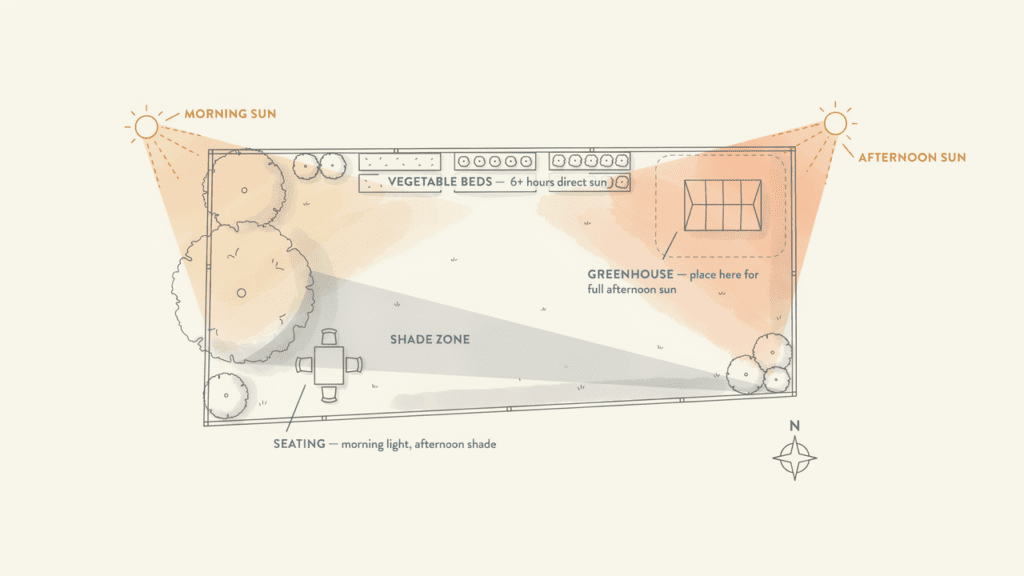
Before deciding where to put seating, plants or a greenhouse, spend a bit of time watching where the sun hits the garden.
This matters more than people think.
A seating area might look perfect at the bottom of the garden, but if it is always in shade, you might not use it much. A greenhouse needs good light. Some plants will struggle in deep shade, while others will cope well.
Try to notice:
- Where the morning sun lands
- Where the garden is brightest in the afternoon
- Which areas stay damp or shaded
- Which corners feel most private
- Where you naturally want to sit
In a small garden, getting the seating position right can make a huge difference.
Decide your must-haves and nice-to-haves
This is where you need to be honest.
Most small gardens cannot comfortably fit everything. You might want a pond, greenhouse, shed, seating area, lawn, raised beds and BBQ area, but squeezing too much in can make the garden feel cluttered.
Split your ideas into two lists.
Your must-haves are the things the garden really needs.
For example: A seating area, A shed, Some privacy, Easy-care planting, A safe path, A small lawn
Your nice-to-haves are the extras.
For example: A pond, A greenhouse, A pergola, A pizza oven, A water feature, Decorative lighting, Extra raised beds.
This does not mean you cannot have the extras. It just helps you plan properly. Get the essentials right first, then add the extras if the space and budget allow.
Set a realistic budget
A small garden makeover can cost very little or quite a lot, depending on what you are changing.
Painting fences, adding pots, improving borders and buying a small seating set can be relatively affordable.
But costs rise quickly when you add paving, decking, fencing, landscaping, electrics, large sheds or professional labour.
Break the budget into sections:
- Seating
- Plants
- Compost and soil
- Pots and planters
- Fencing or screening
- Patio, gravel or decking
- Lighting
- Storage
- Greenhouse or growhouse
- Pond or water feature
- Tools
- Labour, if needed
It is also worth keeping some money aside for unexpected costs. Gardens often come with surprises, especially if you start lifting old paving, removing shrubs or changing levels.
Do the makeover in phases
You do not have to do everything at once.
In fact, with a small garden, doing it in stages can be better. It gives you time to see how the space works before committing to expensive changes.
A simple phased plan could look like this:
Phase one: clear the garden, measure it and decide the layout.
Phase two: sort the main seating area and storage.
Phase three: add planters, raised beds and privacy screening.
Phase four: add extras like lighting, a greenhouse or pond.
Phase five: finish with styling, cushions, pots and decorative details.
This approach is useful if you are busy, working with a limited budget, or planning the garden for next year rather than starting immediately.
Think about maintenance
A garden can look amazing when it is first finished, but the real test is whether you can keep it looking good.
Before choosing a design, think about how much time you realistically want to spend maintaining it.
Low-maintenance features include:
- Gravel areas
- Raised beds
- Hardy shrubs
- Evergreen plants
- Large pots
- Mulch
- Simple seating areas
- Good storage
- Slow-growing plants
- Higher-maintenance features include:
- Large lawns
- Lots of bedding plants
- Complex ponds
- Fast-growing hedges
- Delicate plants
- Untreated timber
A low-maintenance garden does not have to look boring. In fact, simple planting, tidy edges, good seating and a few strong features often look better than a garden with too much going on.
Do not forget storage
Storage is not the most exciting part of garden design, but it makes a big difference.
In a small garden, clutter stands out quickly. Tools, cushions, compost bags, toys, BBQ equipment and plant pots can make the space feel messy if they do not have a proper place.
You could use:
- A small shed
- A garden storage box
- A bench with storage
- Wall hooks
- Shelving inside a shed
- Tall narrow storage units
If you already have a shed, plan around it properly. A shed at the bottom of the garden can actually help frame the space, especially if you paint it, add planting around it, or use it as a backdrop for a seating or growing area.
Choose one main feature
A small garden usually works best when it has one main focus.
That might be:
- A cosy seating area
- A small pond
- A greenhouse
- A pergola
- A feature tree
- A raised bed section
- A painted shed
- A fire pit area
Trying to make everything the main feature can make the garden feel busy. One strong focal point gives the space a clearer look.
For example, if your main feature is a seating area, then the rest of the garden should support that. You might add privacy screening, pots, lighting and a simple path leading to it.
If your main feature is a greenhouse, you might build the design around growing, raised beds and practical storage.
Look at the garden from inside the house
This is something people often forget.
In the UK, you may spend more time looking at your garden from inside the house than sitting in it, especially during winter.
Stand by the back door or kitchen window and look out.
- What do you see first?
- Is it the shed?
- The fence?
- A blank wall?
- Bins?
- A messy corner?
A small change to the main view can make the whole garden feel better. For example, painting the shed, adding a planter, improving the fence line or adding a simple path can improve the garden even when you are indoors.
Avoid buying random things too early
This is one of the easiest mistakes to make.
You see a nice bench, a few pots, some solar lights or a water feature and buy them before you know the full plan.
Then later, nothing quite matches. The bench is too big. The pots are the wrong style. The lights do not fit where you need them. The water feature has nowhere sensible to go.
Before buying, decide:
- Where it will go
- What purpose it serves
- Whether it fits the style
- Whether it fits the budget
- Whether it works with the rest of the garden
A bargain is only a bargain if it actually suits the space.
Pick a simple style
You do not need a complicated design theme, but it helps to have a general style in mind.
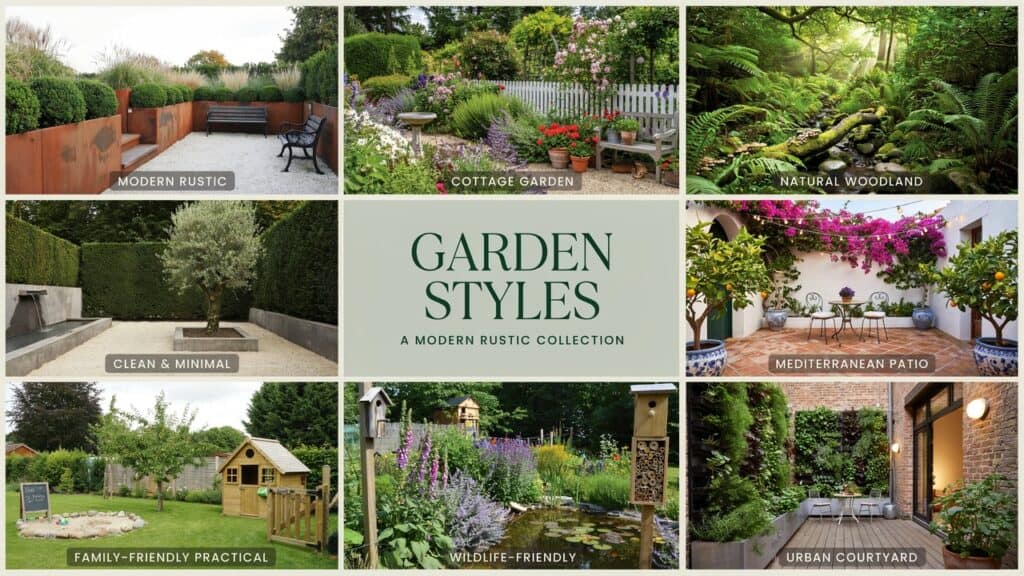
For small UK gardens, these styles work well:
- Modern rustic
- Cottage garden
- Natural woodland
- Clean and minimal
- Mediterranean patio
- Family-friendly practical
- Wildlife-friendly
- Urban courtyard
Once you choose a style, it becomes easier to pick colours, furniture, pots and plants.
For example, a rustic garden might use timber, gravel, terracotta pots, soft planting and warm lighting.
A modern garden might use black planters, clean paving, simple furniture and structured evergreens.
Make a simple shopping list
Once you have a layout and budget, make a shopping list before buying anything.
Split it into:
Must buy now
Can wait
Only buy if budget allows
This helps stop impulse buying.
Your first shopping list might include basic things like fence paint, compost, a few planters, seating, gravel, weed membrane, solar lights and some hardy plants.
Bigger purchases like a greenhouse, pond kit or pergola can wait until the layout is clearer.
Final thoughts
A small garden makeover does not have to start with spending money.
It starts with planning.
Measure the space, think about how you want to use it, understand where the sun goes, set a realistic budget and decide what matters most.
The best small gardens are not always the most expensive. They are the ones that feel useful, comfortable and thought through.
Before you buy anything, make a plan. Even a rough sketch and a simple list can save you money, time and frustration later.
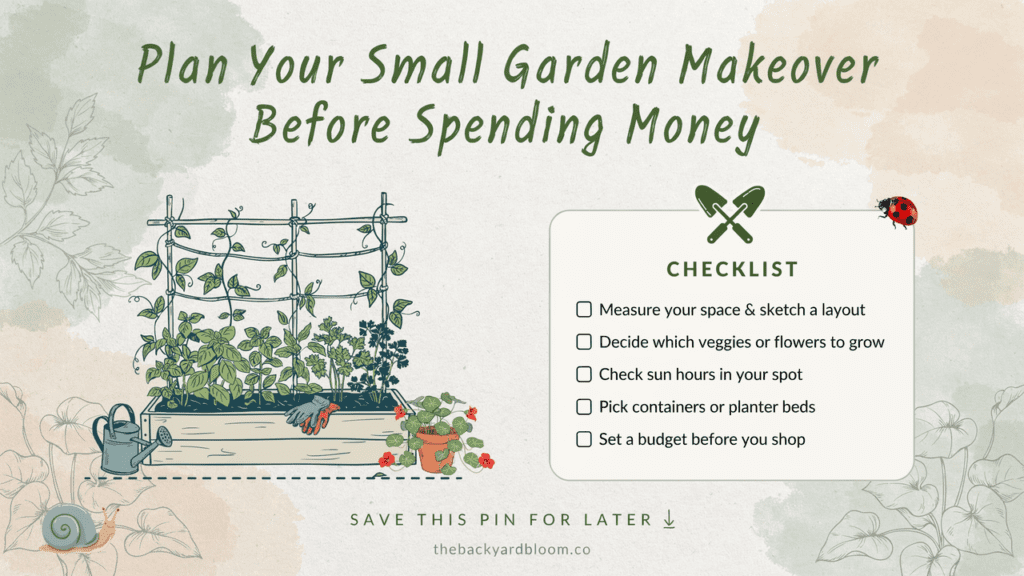
Planning your own small garden makeover?
Download the free Small Garden Makeover Checklist and plan your layout, budget, seating, privacy, planting and must-have features before spending money.