
Best Bird Feeders for Small UK Gardens: 7 Easy-to-Clean Options
Affiliate disclosure: This article contains affiliate links. If you buy through one of these links, we may earn a small commission at no extra cost to you. As an Amazon Associate I earn from qualifying purchases.
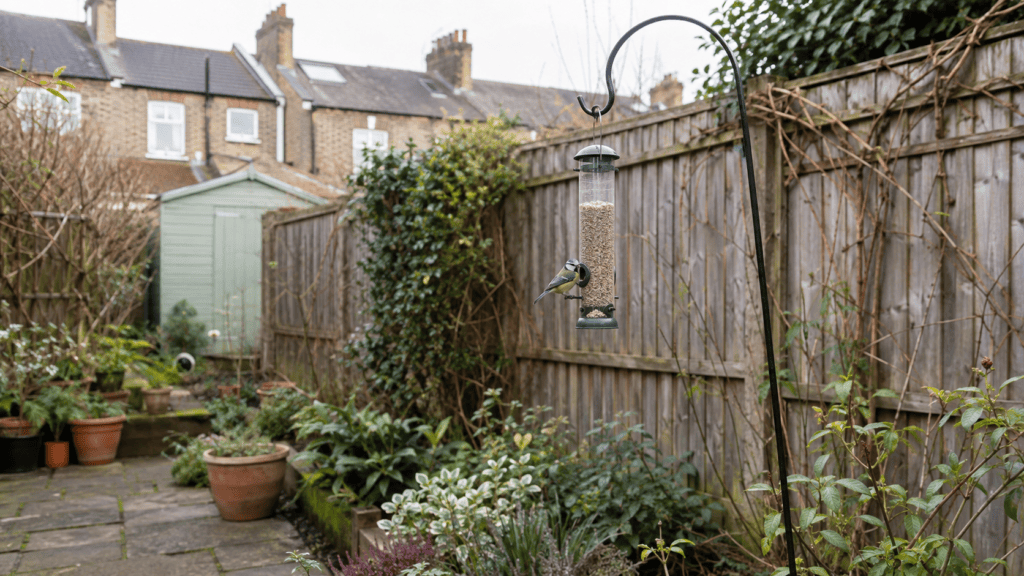
A bird feeder is one of the few things you can add to a small garden that makes the space feel busier without making it feel more cluttered. Put the right one in view of the kitchen window and an ordinary tea break suddenly has live entertainment.
The wrong feeder is less charming. It becomes a tube of damp seed with a queue of pigeons underneath, a squirrel hanging from the lid and several tiny screws that vanish the moment you try to clean it.
For a compact garden, the best feeder is not necessarily the one with the largest capacity or the longest list of birds on the packaging. It is the one you can take apart every week, refill without showering the patio in seed, and move to a fresh position without rearranging half the garden.
This shortlist focuses on easy-to-clean hanging feeders with no seed-catching tray. It includes compact models for a tiny patio, specialist feeders for niger seed and peanuts, and two stronger options for gardens where squirrels or larger birds are getting most of the food.
The quick answer: the four-port Jacobi Jayne Ring-Pull Click Seed Feeder is the best all-round choice for most small gardens because it fully dismantles without tools. Choose the two-port version if space is tight or bird traffic is light. If squirrels are the real problem, look at the Brome Squirrel Buster Standard or the larger Roamwild PestOff 3.0. For the 1 May to 31 October period, pause seeds and peanuts under the latest RSPB guidance and use only small amounts of suet, fatballs or mealworms instead.
Important 2026 bird-health update: On 24 July 2026, the RSPB issued new “Feed Safely, Feed Seasonally” advice. It recommends pausing seeds and peanuts from 1 May to 31 October. Small amounts of mealworms, fatballs or suet can still be offered. From 1 November to 30 April, the full range of bird foods, including seeds and peanuts, can be used. The RSPB also advises choosing hanging feeders over flat surfaces and retiring bird tables, window feeders and feeders with trays. Read the full RSPB seasonal feeding guidance before putting food out.
How these feeders were chosen
This is a researched buying guide, not a claim that all seven models have been personally tested. The shortlist is based on current manufacturer and retailer specifications, the ability to dismantle a feeder for cleaning, size, food type, weather protection and suitability for a compact UK garden.
Easy cleaning carried more weight than decorative styling. A pretty feeder that traps old food in the base is not a bargain. I also looked for an honest drawback in every option, because even the best feeder can be the wrong one for a particular garden.
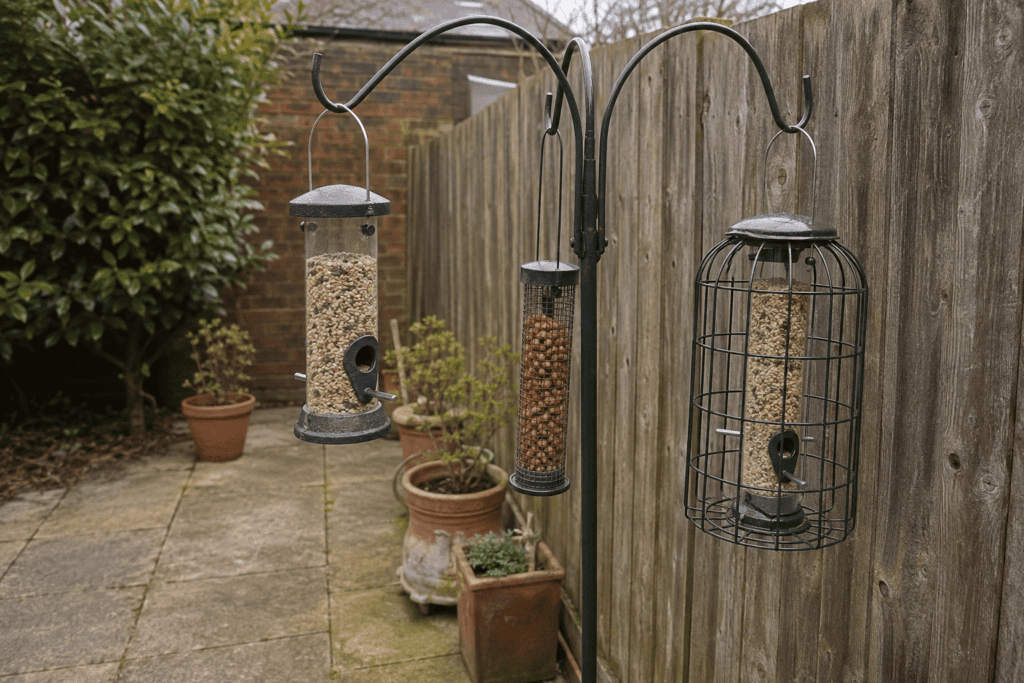
The best bird feeders for small UK gardens at a glance
| Feeder | Size and capacity | Best for | Food and season | Main drawback |
|---|---|---|---|---|
| 1. Ring-Pull Click Seed, 4 port | 36cm tube; 6.2cm diameter; 1 litre | Best overall | Seed, 1 Nov–30 Apr | More expensive than a basic plastic tube |
| 2. Ring-Pull Click Seed, 2 port | 18cm tube; about 0.5 litre | Tiny patios and light traffic | Seed, 1 Nov–30 Apr | Needs refilling more often |
| 3. Peckish Funnel Seed Feeder | H27 × W15 × D15cm | Simple refilling on a smaller budget | Seed, 1 Nov–30 Apr | Bulkier than a slim tube |
| 4. Ring-Pull Click Niger, 2 port | 18cm tube; about 0.5 litre | Niger seed and goldfinches | Niger seed, 1 Nov–30 Apr | A specialist feeder, not an all-rounder |
| 5. Ring-Pull Click Peanut, small | 18cm mesh tube; about 0.3kg | Peanuts in winter; small suet pellets in season | Peanuts Nov–Apr; small amounts of suet May–Oct | Mesh takes longer to scrub and dry |
| 6. Brome Squirrel Buster Standard | H33.7 × W12.7 × D12.7cm; 0.7 litre | Compact squirrel resistance | Seed, 1 Nov–30 Apr | More parts and needs clear space around it |
| 7. Roamwild PestOff 3.0 | H54 × W19 × D19cm; 2 litres; 0.7kg empty | Persistent squirrels and larger birds | Seed, 1 Nov–30 Apr | Large, premium-priced and only two ports |
Dimensions and capacities are based on current manufacturer or retailer specifications and should be checked against the selected Amazon variant before ordering. Do not fill a large feeder simply because it holds more: the RSPB recommends offering only enough seed or peanuts to be eaten within one or two days.
1. Jacobi Jayne Ring-Pull Click Seed Feeder, 4 port
Best overall for most small gardens
If you want one sensible seed feeder rather than a collection of increasingly mysterious tubes, this is the strongest all-round choice. The 36cm tube has four ports and a one-litre capacity, but the real attraction is the dismantling system. The base twists off and the metal ports click away, so you can reach the places where damp seed normally lodges.
The narrow 6.2cm body does not look cumbersome in a small garden and four ports give birds more than one place to feed. Its metal fittings are also a better long-term prospect than the very cheapest plastic ports.
What to know: one litre is more capacity than many small gardens need under the new feed-in-moderation advice. There is no prize for filling it to the top. Start with a small amount, see what is eaten within a day or two, and adjust from there.
Honest drawback: it costs more than a basic plastic feeder, and it is unnecessary if only one or two birds visit occasionally.Check the Ring-Pull Click 4-port feeder on Amazon UK
2. Jacobi Jayne Ring-Pull Click Seed Feeder, 2 port
Best for the tiniest garden or a first feeder
This is the compact version of the feeder above: an 18cm tube, two ports and roughly half a litre of capacity. It suits a narrow patio, a small courtyard or anyone who wants to learn how much food the local birds actually use before buying something larger.
Small capacity is not automatically a compromise. Fresh food is the goal, and a feeder you empty and clean regularly is more useful than a giant cylinder that sits half-full through wet weather. The same tool-free base and removable ports make the weekly routine straightforward.
Honest drawback: two ports limit the number of birds that can feed at once, and a genuinely busy garden will need more frequent top-ups. That may be exactly the right trade-off in a small space.Check the compact Ring-Pull Click feeder on Amazon UK
3. Peckish Funnel Seed Feeder
Best simple feeder for quick filling and emptying
The Peckish Funnel is a practical alternative if you find conventional lids and narrow openings fiddly. Its funnel-shaped top helps guide seed into the body, while a quick-release base and removable ports make it easier to empty and clean than many low-cost feeders.
At approximately 27cm high and 15cm across, it is still small-garden friendly, although it has a wider visual footprint than the slim Ring-Pull models. It can take standard seed mixes or sunflower hearts during the November-to-April feeding period.
Honest drawback: the broader plastic body will not feel as durable or discreet as a narrow metal-trimmed tube. Give it a reasonably sheltered position and check that rain has not worked into the food.Check the Peckish Funnel Seed Feeder on Amazon UK
4. Jacobi Jayne Ring-Pull Click Niger Feeder, 2 port
Best specialist option for niger seed
Niger seed is tiny enough to pour through an ordinary seed port, so it needs a feeder designed for the job. This two-port model uses small openings to reduce waste and keeps the same twist-off, click-apart construction as the general seed version.
The 18cm tube and roughly half-litre capacity are a good match for a compact garden. Goldfinches and siskins may use niger feeders, although no feeder can promise a particular species. Sometimes the birds find it quickly; sometimes they ignore your carefully chosen purchase and inspect a dead sunflower instead.
Honest drawback: this feeder does one job. It is not suitable for ordinary seed mixes, and under the July 2026 RSPB guidance the niger seed should be paused from 1 May to 31 October.Check the Ring-Pull Click Niger feeder on Amazon UK
5. Jacobi Jayne Ring-Pull Click Peanut Feeder, small
Best dual-purpose mesh feeder
A mesh feeder allows birds to take small pieces from whole peanuts more safely than offering loose peanuts on a flat surface. The small Ring-Pull Click version has an 18cm stainless-steel mesh tube, a twist-off base and metal fittings. It can also hold suitable suet pellets, which makes the feeder more useful across the year.
From November to April, use good-quality bird peanuts and offer only what will be eaten in a day or two. From May to October, pause peanuts and use only small amounts of suet pellets if you want to keep this feeder in service. Avoid hanging peanuts or fatballs in plastic netting.
Honest drawback: mesh takes more attention than a smooth tube. Peanut dust and softened suet can lodge in the openings, so use a firm brush, rinse thoroughly and let it dry completely before refilling.Check the small Ring-Pull Click Peanut feeder on Amazon UK
6. Brome Squirrel Buster Standard
Best compact weight-activated feeder
The Squirrel Buster Standard uses a moving outer shroud: when a squirrel or heavier visitor puts its weight on the feeder, the shroud drops and covers the seed ports. Lightweight birds can continue to use the four perches.
The body is about 33.7cm high and 12.7cm wide, with a capacity around 0.7 litres. That makes it less imposing than many full-sized squirrel-resistant feeders. It dismantles without tools and replacement support is one reason this design has lasted.
Honest drawback: it has more parts to clean than a simple tube. It also needs open space around it. If a squirrel can brace itself on a fence, branch or hook, it may reach the food without putting its full weight on the mechanism. “Squirrel-resistant” is a more sensible expectation than magical squirrel invisibility.Check the Brome Squirrel Buster Standard on Amazon UK
7. Roamwild PestOff 3.0
Best for persistent squirrels, pigeons and seed spill
The current PestOff 3.0 is the heavy-duty option in this list. Its two spring-loaded ports close under heavier visitors, while rain guards and an internal seed shield are intended to keep food dry and reduce the shower of seed that can attract rodents below.
It holds up to two litres and measures about 54 × 19 × 19cm, so it is not a dainty feeder. The tube clicks apart without tools and the manufacturer specifies mixed seed or sunflower hearts. In a small garden, the useful feature is not the large capacity; it is the combination of weather protection, reduced spillage and weight-activated access. Continue to add only a modest amount of food.
Honest drawback: it is the largest and likely the most expensive option here, yet it still offers only two feeding ports. Birds may also need time to accept a new-looking feeder. Hang it alongside a familiar feeder at first, then let the old one run down rather than forcing an overnight change.Check the current Roamwild PestOff 3.0 options on Amazon UK
Which feeder should you actually buy?
If your garden has no obvious squirrel problem, start simple. The two-port Ring-Pull Click is enough for a first feeder, while the four-port version makes sense when several birds are already visiting. There is little reason to pay for a weight mechanism until you know you need one.
Choose the feeder around the problem:
- Very little hanging space: the two-port Ring-Pull Click Seed Feeder.
- You want one dependable seed feeder: the four-port Ring-Pull Click.
- You struggle with awkward lids: the Peckish Funnel.
- You specifically want to offer niger seed: the two-port Niger feeder.
- You want peanuts in winter and suet pellets in summer: the small mesh Peanut feeder.
- You need compact squirrel resistance: the Squirrel Buster Standard.
- Squirrels, pigeons and spilled seed are all problems: the PestOff 3.0.
In a tiny garden, two small feeding stations can be better than one crowded feeder, provided you can clean and move both. Separating them reduces the number of birds gathering in one place. Do not buy a row of feeders on day one. Start with one, watch what happens and add a second only if it solves a clear problem.
Where to put a bird feeder in a small garden
A feeder needs to be visible enough for you to enjoy, safe enough for birds to use and convenient enough that weekly cleaning does not become a special expedition.
- Use a hook or pole rather than a flat surface. This follows the current RSPB advice and makes moving the feeder easier.
- Keep nearby cover available, but not directly underneath. Birds appreciate somewhere to retreat, while food placed under a regular roosting point is more likely to be contaminated by droppings.
- Move the feeding position every week. Even shifting a freestanding hook to a different paving slab helps prevent a concentrated patch of old food and droppings.
- Clear debris below. A “no mess” seed mix can reduce husks, but it does not remove the need to sweep.
- Give weight-activated feeders clearance. A nearby fence or branch can become a squirrel’s handy side entrance. The RSPB buying guide suggests positioning squirrel-resistant feeders around two metres from jump-off points where space permits.
- Keep cats in mind. Avoid placing the feeder where a cat can wait unseen in dense low cover immediately below.
Small-garden fix: a freestanding shepherd’s hook is easier to move weekly than a feeder screwed permanently to a fence. If the base sits on paving, choose a stable design and place it where it will not narrow the main path.
How to clean a bird feeder properly
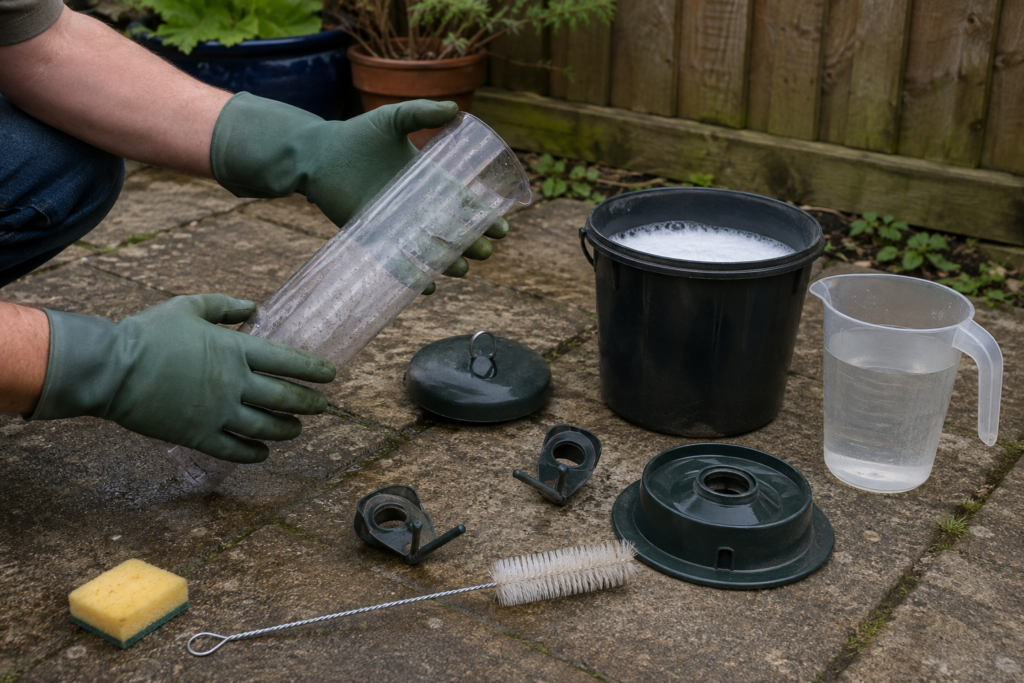
The RSPB recommends cleaning feeders at least weekly. Do the job outdoors and wear gloves. It is not complicated, but “a quick rinse while still assembled” is not the same as cleaning the places where old food collects.
- Empty leftover food into an outdoor household bin. Do not reuse or compost it.
- Take the feeder completely apart.
- Scrub every part in hot soapy water with a bottle brush or long-handled feeder brush.
- Rinse, then disinfect with an animal-safe product or a mild 5% bleach solution, following the RSPB instructions.
- Rinse again with fresh water.
- Leave every component outside until completely dry before reassembling and adding fresh food.
- Wash your hands and forearms afterwards, and clean old food or droppings from beneath the feeder.
If you see a bird that appears sick, stop feeding and empty bird baths. Current RSPB advice is to wait at least three weeks and resume only when no birds are showing signs of disease. Suspected wildlife illness can be reported to the Garden Wildlife Health project.
What food should go in the feeder—and when?
The feeder and the food have to match. Trying to put niger seed in a general seed tube creates expensive confetti; putting loose peanuts in an open tray creates a different set of problems.
1 November to 30 April
You can offer the full range of bird foods, including seed mixes, sunflower hearts, niger seed and peanuts. Put out only what is likely to be eaten within one or two days, keep it dry and reduce the amount if food is left behind.
1 May to 31 October
Pause seeds and peanuts. The RSPB says small amounts of mealworms, fatballs or suet can continue. Suet products can remain out for up to seven days if they stay in good condition, while mealworms should be eaten or cleared away by dusk on the same day.
This seasonal pause is also a useful reminder that a feeder is only one part of a bird-friendly garden. Plants can provide natural food and shelter without creating one crowded feeding point.
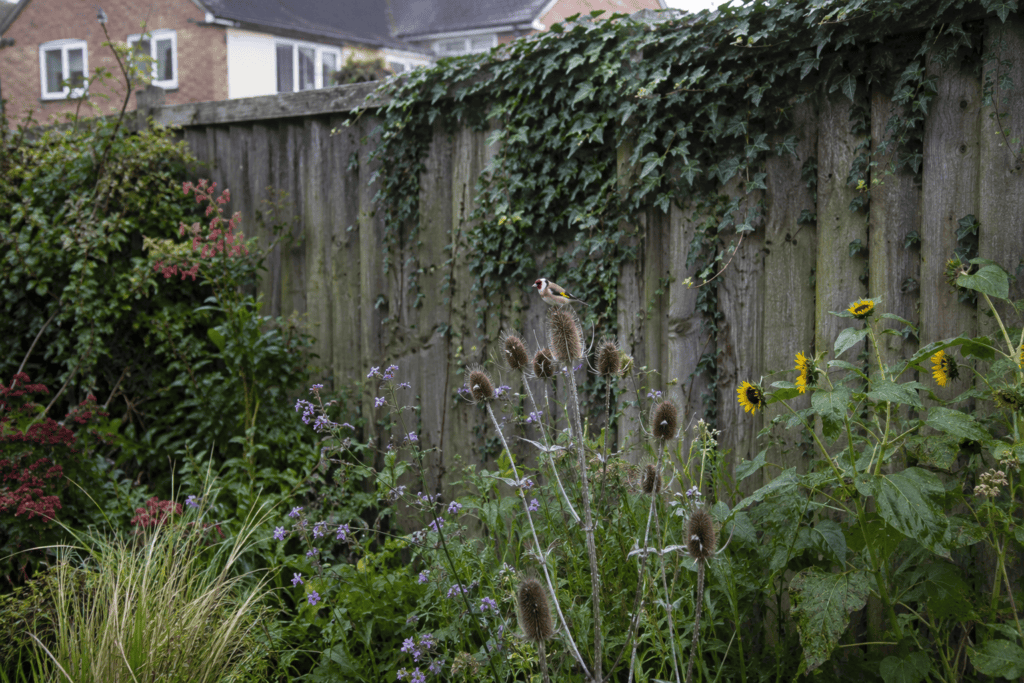
Make the rest of the garden useful to birds
You do not need to turn a small garden into a wilderness. Leave a few seed heads standing, grow ivy where it can be controlled, add a compact sunflower and avoid making every corner completely bare. Teasels, sunflowers and ivy are among the plants suggested in the RSPB’s current guidance.
If you are planning a mini wildlife area, combine one or two useful plants with a clean hanging feeder and a water source only if you can maintain it. The latest advice is to refresh bird-bath water with fresh tap water every day and disinfect the bath weekly. If that routine is unrealistic, a small wildlife pond may be a better long-term water source where space and safety allow.
Bird feeder questions
Are window bird feeders safe?
The RSPB’s July 2026 guidance advises against window feeders because they are flat feeding surfaces where contaminated food can collect. For a small garden, use a slim hanging feeder on a hook or bracket instead.
Is a seed tray under a tube feeder a good idea?
A tray catches seed, but it also creates a shared flat surface. The latest RSPB advice is not to use feeders with trays. A feeder with protected ports and an internal anti-spill design is a better route if waste is the problem.
How often should I clean a bird feeder?
At least once a week, and sooner if the food becomes wet, mouldy or contaminated. The ground below also needs cleaning, and the feeder should be moved to a fresh position weekly.
Can I feed birds all year?
Yes, but not with the same foods. From 1 May to 31 October, the RSPB recommends pausing seeds and peanuts while allowing small amounts of mealworms, fatballs or suet. From 1 November to 30 April, seeds and peanuts can return alongside other appropriate foods.
What size feeder is best for a small garden?
A two-port feeder is usually enough to start. Move up to four ports if birds are regularly waiting, or use two small feeders in separate spots to reduce crowding. Capacity should follow demand, not the size of the bag of seed you bought.
Are squirrel-proof feeders really squirrel-proof?
No design defeats every squirrel in every position. Weight-activated ports and guardian cages can reduce access, but placement matters just as much. A squirrel that can lean from a fence may bypass the mechanism entirely.
The final choice
For most small gardens, the four-port Ring-Pull Click is the easiest recommendation: narrow, properly dismantlable and large enough without looking industrial. The two-port version is the smarter buy when you are just starting or have very little room.
If squirrels are turning every refill into a donation, the Brome Squirrel Buster Standard offers compact weight-activated protection. The Roamwild PestOff 3.0 makes more sense when larger birds, weather and spill are all part of the problem and you do not mind a bigger feeder.
Whichever one you choose, the useful habit matters more than the clever mechanism: offer the right food for the season, keep the amount modest, clean every week and move the feeding point. That is what turns a feeder from garden ornament into something genuinely helpful.
Sources and further guidance
- RSPB: latest guidance on what and when to feed garden birds
- RSPB: bird feeder cleaning and disease-reduction guide
- RSPB: feeder types and warning about mesh food bags
- RSPB Shop: bird feeder buying guide
Product specifications were checked on 9 August 2026. Amazon stock, product variants and wildlife guidance can change; verify the selected listing and latest official advice before publishing or buying.