12 Low-Maintenance Small Garden Ideas for People Short on Time
Affiliate disclosure: This article contains affiliate links. If you buy through one of these links, we may earn a small commission at no extra cost to you. As an Amazon Associate I earn from qualifying purchases.
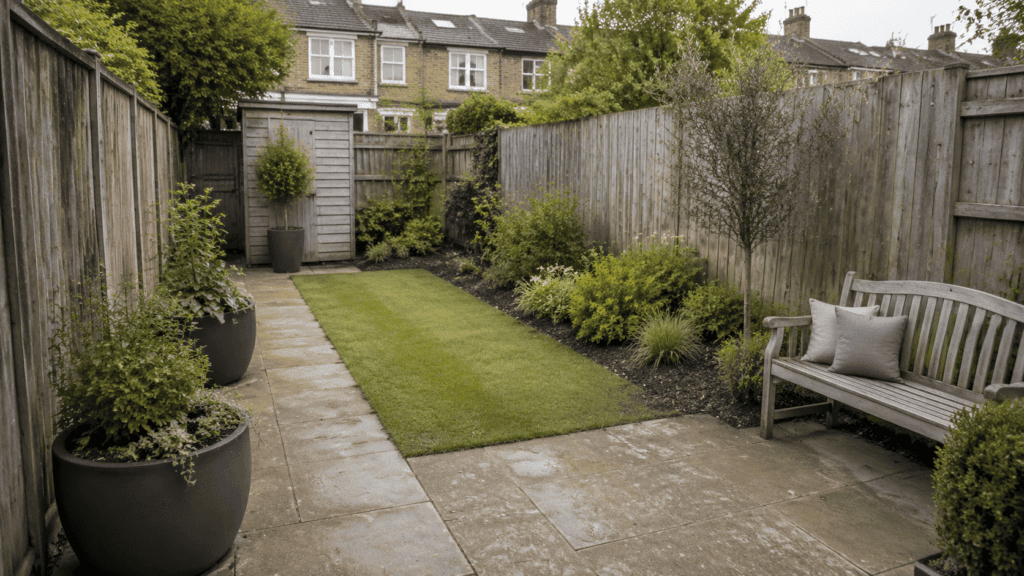
“Low maintenance” is often presented as a choice between working in the garden every evening and covering the entire thing in grey gravel. Fortunately, there is a rather large middle ground.
A genuinely easy-care garden can still have flowers, birds, herbs, a small patch of lawn and somewhere pleasant to sit. The trick is to remove the jobs you resent, not everything that is alive.
In a small garden, maintenance problems are rarely caused by the total area. They come from dozens of separate little tasks: fifteen pots that all dry out at different speeds, a lawn edge the mower cannot reach, a fast-growing shrub planted six inches from a path, and tools stored at the far end of the house.
These low-maintenance small garden ideas for UK homes focus on reducing that repetition. Some are free layout changes, some need a weekend of work, and a few involve buying a product that earns the space it occupies.
The short version: keep one clear route, grow fewer plants in larger containers, put water close to where it is needed, mulch bare soil, and choose plants by their mature size and growing conditions. Make lawn edges easy for the mower, store the few tools you use near the job, and leave one controlled wildlife corner rather than trying to keep every inch permanently immaculate.
What does “low maintenance” actually mean?
No garden is maintenance-free. Even an empty paved yard needs sweeping, drainage checks and occasional weed removal. The useful question is not, “How do I do nothing?” It is, “Which jobs keep coming back, and how can I make them smaller?”
For one person, that may mean reducing watering. For somebody else it is avoiding kneeling, keeping paths clear or not spending every Sunday cutting grass. The RHS recommends starting with the amount of input you can realistically give and keeping the garden features that matter most to you. That is much more useful than following a generic list of supposedly easy plants.
A simple rule: spend money only when it removes a repeated job. A water butt close to ten pots may save effort every dry week. A decorative gadget used twice is simply another object to clean around.
The 12 ideas at a glance
| Idea | Setup | What it reduces | Watch out for |
|---|---|---|---|
| 1. Audit the jobs you dislike | 30 minutes | Wasted effort and random purchases | Trying to solve everything at once |
| 2. Keep one route completely clear | Free to low | Moving pots, tripping and awkward cleaning | Making the path too narrow in use |
| 3. Replace tiny pots with fewer large ones | Low to medium | Watering and visual clutter | Weight and drainage |
| 4. Add reservoirs to thirsty containers | Low to medium | Frequent summer watering | Overfilling and poor outdoor drainage |
| 5. Put stored water near the plants | Medium | Carrying watering cans through the house | A full 100L butt weighs over 100kg |
| 6. Use micro-drip where it solves a real problem | Medium | Watering many containers individually | Blocked drippers and leaks |
| 7. Mulch bare soil | Low | Weeding and moisture loss | Applying it too thinly or against stems |
| 8. Buy plants at their mature size | Free planning | Constant pruning and moving | Believing the size of the pot is the size of the plant |
| 9. Close gaps with suitable groundcover | Low to medium | Open soil and repeat weeding | Using invasive or unsuitable plants |
| 10. Simplify lawn and edges | Free to medium | Strimming and fiddly mowing | Replacing one maintenance job with another |
| 11. Use fewer, better-positioned tools | Low to medium | Bending, walking and putting jobs off | Buying tools too large to store |
| 12. Plan two tidy-ups, not fifty-two | Free | Constant deadheading and “pottering” | Letting paths or access disappear |
Useful buys that can genuinely remove work
These are examples, not a compulsory shopping list. The dimensions come from current manufacturer information and should be checked against the selected Amazon variant.
| Product type | Useful specification | Best for | Honest drawback | Link |
|---|---|---|---|---|
| Outdoor self-watering planter | Choose a reservoir and overflow suitable for outdoor use; measure the full external width | One or two consistently thirsty pots | Still needs checking; not every plant likes permanently wet compost | Browse outdoor self-watering planters |
| Strata/Ward 100L slimline water-butt kit | Approx. H96 × W32 × D36cm; stand, tap and diverter supplied on the current kit | A narrow side return or wall beside a downpipe | Needs a stable level base and compatible plastic downpipe | Check the 100L slimline water butt |
| Hozelock 15 Pot Watering Kit | 15m micro-tube with 15 pressure-compensating 4L-per-hour drippers | A patio collection that takes too long to water | Setup takes thought and every dripper still needs checking | Check the Hozelock 15 Pot kit |
| Spear & Jackson Kew long-handled Dutch hoe | 152.4cm shaft; 12.7cm head | Regular light hoeing without kneeling | The long handle needs proper vertical storage | Check the long-handled Dutch hoe |
| Bosch Isio cordless grass and shrub shear | Approx. 33.6 × 8.2 × 11.8cm; 550g; up to 50-minute no-load runtime | Small topiary, young shrubs and awkward lawn edges | It is a light trimmer, not a replacement for a full hedge cutter | Check the Bosch Isio on Amazon UK |
Amazon availability changes.
1. Start with a maintenance audit, not a shopping basket
For one week, notice which garden jobs annoy you. Write them down without turning it into a horticultural performance review. “Watering pots takes too long” is useful. “The whole garden is a mess” is not specific enough to fix.
Typical repeat offenders are:
- carrying water to scattered containers;
- moving furniture or pots to sweep;
- strimming around complicated lawn edges;
- cutting a shrub that was always going to outgrow its spot;
- searching for tools; and
- weeding soil that has been left bare.
Choose the three jobs that happen most often. Those are your design brief. If mowing takes ten minutes but watering takes an hour, replacing the lawn is unlikely to be the clever first move.
2. Keep one route completely clear
A clear path sounds basic, but it removes an astonishing amount of low-level faff. You should be able to walk from the back door to the seat, shed, bin or gate without moving a pot, folding a chair or squeezing past a shrub.
Measure the route when everything is in use. A storage-box lid needs room to open. A chair needs space for somebody to sit in it. A plant label describing a 60cm spread does not mean the plant will politely stop at 59cm.
Place the higher-maintenance things—herbs you pick, seedlings you check and pots you water—near the house or water source. Put the genuinely settled plants farther away. This follows a simple principle: the more attention something needs, the fewer steps it should take to reach.
Small-garden fix: before moving anything heavy, mark a 75–90cm route with a hosepipe or masking tape. Walk it while carrying a watering can. If you have to turn sideways, it is not really a clear path.
3. Replace a crowd of tiny pots with fewer large containers
Tiny pots are appealing in the garden centre and surprisingly needy at home. They hold less compost, dry quickly and create a separate watering decision every few feet.
Group the plants worth keeping into two or three larger containers, provided their light, soil and watering needs are compatible. A substantial pot also has enough visual weight to look intentional, while seventeen unrelated small ones can make a patio resemble the queue outside a plant crèche.
Do not make them so large that they become permanent buildings. Check the filled weight, use pot feet where suitable, keep drainage holes clear and put the container in its final position before filling it.
4. Add a reservoir only to the pots that need one
Self-watering planters and reservoir inserts can reduce watering frequency because the plant draws moisture from stored water below. RHS trials on hanging baskets found that a self-watering design produced a similar number of flowers while using about a third less water than the high manual-watering treatment.
That does not mean every pot should become a miniature reservoir. Mediterranean herbs and other plants that dislike sitting wet need free drainage. Outdoor containers also need an overflow route so prolonged rain does not turn the compost into soup.
Use reservoirs where the problem exists: perhaps the sunny tomato pot, a thirsty summer display or the container that always wilts first. Continue checking the compost, especially while roots establish and during very hot weather.
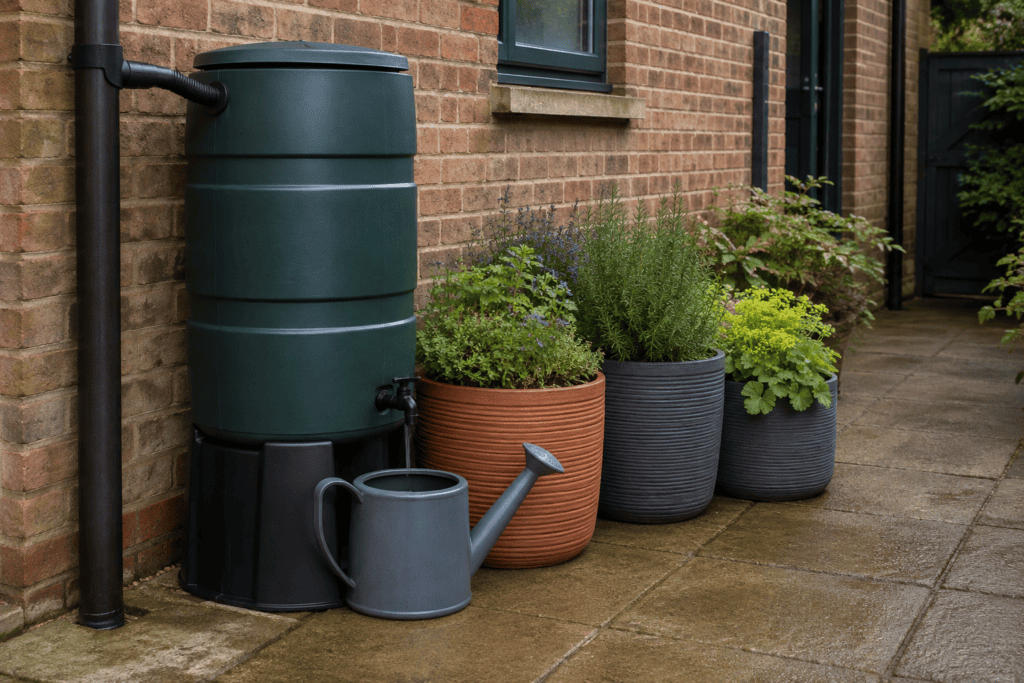
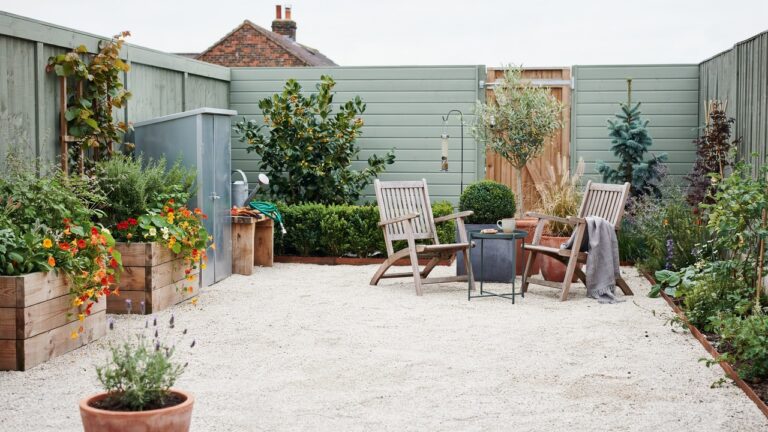
Fewer substantial pots and water stored close by can remove a great deal of carrying. The image is editorial and does not show a named product.
5. Put a slimline water butt close to the plants
If the watering can lives in the kitchen and the pots live at the far end of the garden, every dry spell becomes a shuttle service. A compact water butt beside a downpipe moves the water source to where the job happens.
A representative 100-litre Strata/Ward slimline set is around 96cm high, 32cm wide and 36cm deep. That narrow footprint can work beside a shed or in a side return where a round barrel would block the route. The current set includes a stand, tap and diverter for common plastic downpipes, but check your actual pipe shape and size before ordering.
The base must be solid and level. One hundred litres of water weighs roughly 100kg before the container and stand are added. Use the locking lid, follow the fitting instructions and make sure overflow water cannot run towards the house.
Honest drawback: a slimline butt saves floor width by becoming tall. It needs stability, access to a suitable downpipe and enough room beneath the tap for your watering can.
6. Use micro-drip irrigation where it solves a repeated problem
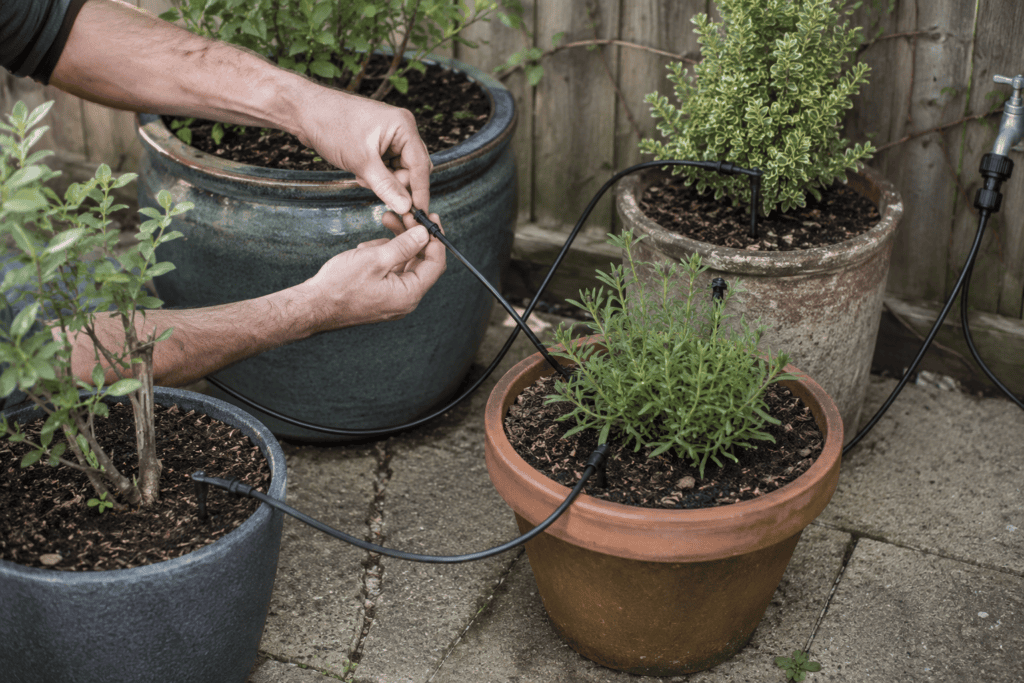
A micro-drip system is useful when you have several permanent containers, a greenhouse bench or a border that is difficult to water evenly. It delivers water near the roots rather than throwing it across leaves and paving.
The Hozelock 15 Pot Watering Kit is a sensible-sized example for a small garden: 15m of micro-tube and 15 pressure-compensating drippers rated at four litres per hour. A smaller collection may need fewer outlets, while mixed pot sizes may need different watering durations or dripper arrangements.
Automatic does not mean abandoned. Run the system while you are present, check every outlet, look for leaks and push the drippers back into place if wildlife or gardening dislodges them. Turn the supply off and deal with frost according to the manufacturer’s instructions.
Do not automate a bad layout: if three pots need constant rescue because they are too small or contain the wrong plants, changing the pots may be simpler than installing pipework around them.
7. Mulch bare soil properly
Mulch is one of the least glamorous and most effective time-savers in a garden. The RHS advises that a layer of material such as garden compost, bark or gravel can conserve moisture, suppress weeds and protect soil. For many organic mulches, aim for a layer at least 5cm deep and apply it while the soil is already moist.
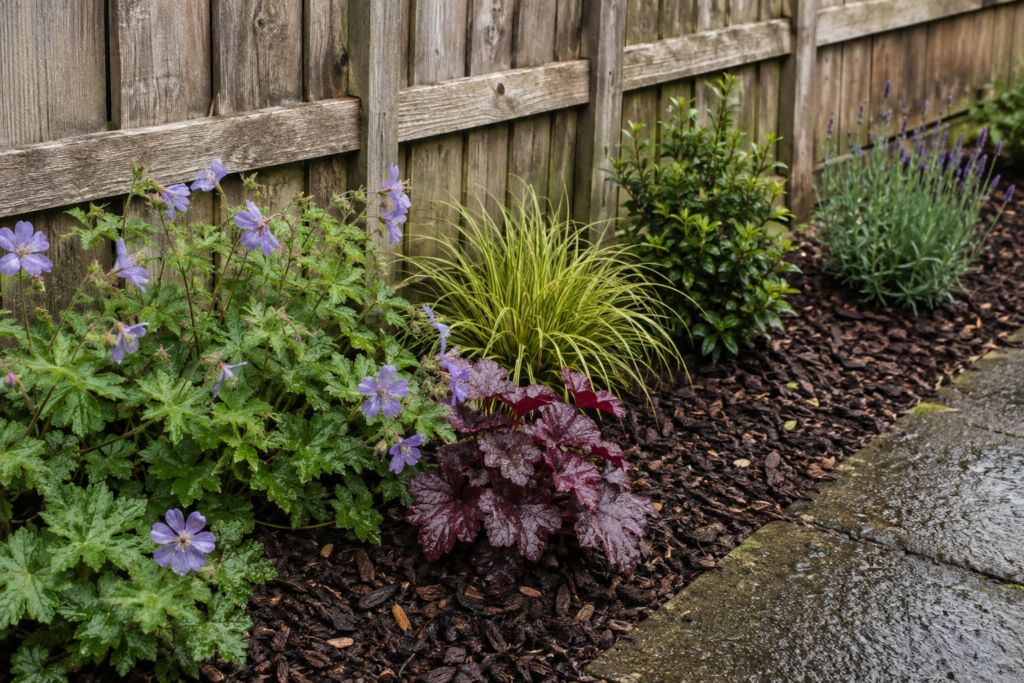
Clear established perennial weeds first. Then spread the mulch evenly without piling it against plant stems, trunks, air bricks or the bottom of a timber fence. A token dusting of bark looks tidy for a fortnight but does little else.
Organic mulch gradually breaks down and improves the soil, so it needs topping up. Gravel can suit dry, sunny planting but is not a universal answer; it is tedious to remove if you change your mind and fallen leaves still land on it.
8. Choose plants by mature size, not the pot they arrive in
A compact garden magnifies a planting mistake. The shrub that looked sweet in a two-litre pot can spend the next five years leaning across the path while you cut it back and wonder why it never looks happy.
Before buying, check:
- eventual height and spread;
- sun or shade preference;
- soil and drainage needs;
- whether it needs regular pruning, staking or lifting; and
- whether it is evergreen, deciduous or dies back in winter.
“Right plant, right place” saves more work than any tool. Hardy evergreens can give useful structure, but even an evergreen becomes high maintenance when planted in a space half its mature width.
Do not fill every gap on planting day. Use the stated mature spread to set spacing, then mulch the temporary bare areas. That slightly restrained first year is cheaper than lifting half the border in year three.
9. Close the gaps with suitable groundcover
Once the main shrubs are positioned, low-growing perennials can shade the soil and reduce open patches where weed seedlings establish. Hardy geraniums, heucheras and epimediums can be useful in suitable conditions; sun-loving thyme and some sedums can work in drier spots.
The important words are “suitable conditions”. Groundcover is not a magic green carpet. A shade plant in a baked south-facing pot will need more care, not less, and a vigorous spreader can become the new maintenance problem.
Start with a small repeated palette rather than one of everything. Three or five plants of the same type usually look calmer and are easier to understand than a border in which every plant has a different annual timetable.
10. Make the lawn and its edges easy to maintain
A small simple lawn can be perfectly manageable. The difficult version is a tiny shape with sharp corners, stepping stones, a tree in the middle and an edge the mower cannot reach.
If you want to keep grass, give it a simple outline and install a firm level edge that a mower wheel can run over. That can remove much of the follow-up strimming. Raise the mower height in dry periods and accept that an established lawn may brown temporarily rather than watering it constantly.
If the lawn is genuinely too awkward to justify itself, replace it because the new surface suits how you use the garden—not because every small-garden makeover apparently requires porcelain slabs. Permeable gravel planting, a larger border, a modest patio or low groundcover may fit. Each still has maintenance, just of a different kind.
11. Use fewer tools and keep them close to the job
The best tool is often the one you can reach without emptying the shed. For a small garden, a useful core set might be secateurs, a hand fork or trowel, a stiff brush and one long-handled weeding tool.
A Dutch hoe slices through small weed seedlings while you remain standing. The Spear & Jackson Kew version has a 152.4cm shaft and a 12.7cm head, so it reaches into a border but needs enough vertical storage. It is for regular light hoeing, not extracting a mature dandelion through concrete.
For a small patch of grass, soft young shrubs or a short edge, compact cordless shears may be easier to store than separate full-sized tools. The Bosch Isio weighs about 550g and is approximately 33.6cm long, with interchangeable grass and shrub blades on the relevant set. Its drawback is also its purpose: it is a light tool, not a machine for tackling an established hedge.
Store tools where they stay dry but close to the work. A slim cabinet, bench box or wall rail can help, provided it does not narrow the path. Buying duplicate tools because the first ones are buried behind furniture is not a storage system.
12. Leave one controlled wildlife corner and plan two tidy-ups
A garden does not become low maintenance by cutting every plant into a green ball. Leaving some perennial stems and seed heads through autumn can reduce immediate work and provide food or shelter for wildlife.
The word “controlled” matters. Keep the path clear, remove diseased material and stop vigorous plants overwhelming their neighbours. But allow one border or corner to look a little less processed, then give it a deliberate tidy in late winter or early spring.
Schedule a second main session in autumn for moving pots, clearing unsafe slippery debris and dealing with anything that has outgrown its space. Between those sessions, do small safety and watering jobs rather than trying to make the garden look freshly edited every weekend.
If you feed garden birds, keep the feeder itself on a strict cleaning routine even if the surrounding planting is relaxed. Current RSPB advice includes weekly feeder cleaning, moving the feeding position and seasonal changes to the food offered.
Things that look low maintenance but often are not
- Lots of tiny containers: less compost means faster drying and more individual watering.
- Fast-growing screening plants in a tight space: privacy arrives quickly, followed by constant cutting.
- Complicated lawn shapes: the mower does half the job and a second tool does the rest.
- A thin decorative mulch: it hides the soil without providing the full benefit.
- Automatic irrigation you never inspect: one blocked outlet can leave a pot dry while the others are watered.
- Seasonal bedding everywhere: colourful, but it often means repeated buying, planting, feeding, watering and removal.
- Furniture without a winter plan: if every cushion needs carrying through the house, the garden has created another routine.
A realistic one-weekend low-maintenance reset
You do not need to rebuild the garden. Start with a reset that makes the next ordinary week easier:
- Write down the three jobs that take most time.
- Clear and measure the main route.
- Group pots by watering and light needs; remove empty or broken ones.
- Move the watering can and tools near their jobs.
- Weed one border thoroughly and apply a proper mulch.
- Mark any shrub that will outgrow its position rather than repeatedly clipping it.
- Choose one upgrade—perhaps a reservoir planter, water butt or hoe—that removes a repeated task.
Stop there and see what changes. A low-maintenance garden is built by removing friction, not by ordering an entire new personality for the patio.
Low-maintenance small garden questions
What is the lowest-maintenance garden surface?
There is no completely maintenance-free surface. Paving needs sweeping and joint care, gravel collects leaves and can migrate, decking needs cleaning and inspection, and lawn needs cutting. Choose according to drainage, access, how you use the space and the maintenance job you are most willing to do.
Are pots low maintenance?
Large containers can be manageable; lots of small pots are usually not. Containers rely on you for water and nutrients because their roots cannot search farther into the soil. Use fewer larger pots, suitable plants, good peat-free compost and reservoirs or drip watering only where useful.
How deep should garden mulch be?
The RHS commonly recommends a layer at least 5cm deep for materials such as bark, compost and manure. Clear established weeds first, apply mulch to moist soil and keep it away from plant stems and structures that must remain ventilated.
Does an automatic watering system mean I can leave pots unattended?
No. Test the full system before relying on it and continue to inspect the plants, connectors and drippers. Pots differ in size, exposure and water need, while outlets can block or move.
Which plants are easiest in a small UK garden?
The easiest plant is one suited to your garden’s light, soil, drainage and available mature space. Hardy geraniums, heucheras, epimediums, lavender, thyme, sedums and compact evergreens can all be useful in the right position, but none is effortless in the wrong one.
How can I make a small garden wildlife-friendly without adding work?
Keep some seed heads and perennial stems, use a few suitable flowering plants, avoid clearing every leaf immediately and provide connected planting rather than isolated ornaments. Keep paths accessible and follow proper hygiene for any feeders or bird baths.
The best place to begin
Do not start by removing the lawn, buying an irrigation computer or declaring war on every fallen leaf. Start with the repeated job you dislike most.
If it is watering, reduce tiny pots and move stored water closer. If it is weeding, clear one border properly and mulch it. If it is pruning, stop buying plants before checking their mature size. If it is general clutter, protect one clear route and give the tools a home.
A good low-maintenance garden still changes through the year. It simply does not demand attention every time you walk past the window.
Sources and further guidance
- RHS: low-maintenance gardening
- RHS: ten ways to create a lower-maintenance garden
- RHS: mulches and mulching
- RHS: garden watering methods
- RHS: self-watering hanging-basket trial
- Waterwise: saving water in the garden
Guidance and representative product specifications were checked on 9 August 2026. Product variants, availability and official advice can change; verify them before publication or purchase.